

Understanding cancer screening and why early detection matters
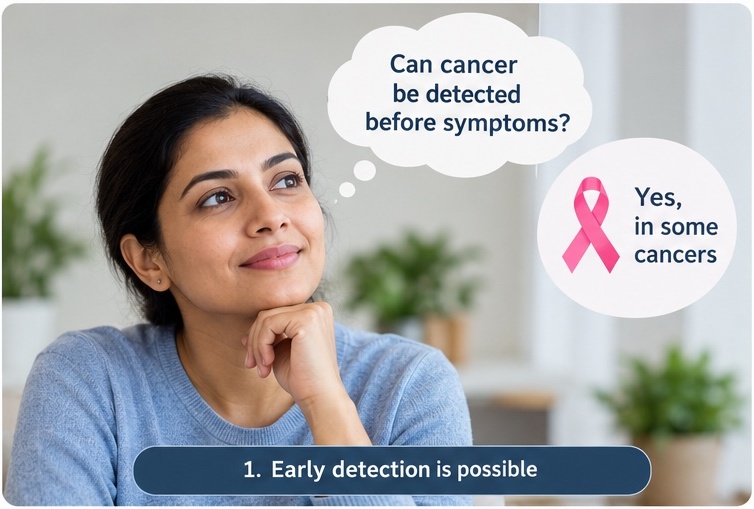
Can we detect cancer in someone who feels perfectly healthy? This question comes up often: what if a person has no pain, no lump, no bleeding and no reason to believe that anything is wrong? Yes, in some cancers, we can.
This is the main idea behind cancer screening: looking for cancer, or changes that may lead to cancer, before a person develops any symptoms.
In our previous articles, we discussed what cancer is and how it develops. We learnt that cancer often begins with changes within a cell. As these changes accumulate, abnormal cells may multiply, form a tumour and, in some cases, spread to nearby tissues or distant parts of the body.
But this raises an important question: What if we could find cancer before it starts growing large enough to cause trouble? What if we could identify some abnormal changes and treat them before they turn into full-blown cancer?
That is exactly what screening aims to achieve.
However, screening is often misunderstood. Some people believe that everyone should undergo a whole-body scan every year. Others assume that if they are healthy, they feel no symptoms, so they have no reason to undergo screening .
The truth is more complicated.
Let’s understand what screening means, who needs it and what it can—and cannot—do.
What does cancer screening mean?
Cancer screening is testing people who have no symptoms, to look for a particular cancer or an early change that may lead to cancer. The aim is to find disease at a stage when treatment may be simpler, more effective and, in some cases, potentially curative.
Consider a woman who feels completely alright but when a mammogram is done, and she’s found to have a small breast cancer that she could not feel herself. Or a woman whose cervical screening test identifies abnormal cells before they develop into cancer. In both these instances, screening has the potential to make a meaningful difference.
It is important to understand that screening does not guarantee prevention or cure. Its value comes from finding certain diseases early enough so that treatment can be initiated. The core idea is simple: we do not always have to wait for cancer to announce itself through visible symptoms.
Screening and diagnosis are not the same
This is a distinction worth understanding. Screening is done in people who have no symptoms. Diagnostic testing is performed when a person has a symptom, an abnormal examination or an abnormal screening result that needs further investigation.
For example, a woman with no breast symptoms who undergoes mammography is having a screening test; or a woman who notices a new breast lump and undergoes mammography or ultrasound is undergoing a diagnostic evaluation. Both are important, but they serve different purposes.
If you notice a persistent or concerning symptom, do not wait for your next screening appointment. Seek medical evaluation promptly.
Screening is designed for people who don’t have any apparent symptoms . Early diagnosis is about acting urgently when something does not feel right.
Which cancers can we screen for?
Not every cancer has a well-established screening test. For some cancers, screening methods have demonstrated benefits in specific populations. For others, routine screening has not shown enough benefit to justify testing everyone.
Some established screening approaches include:
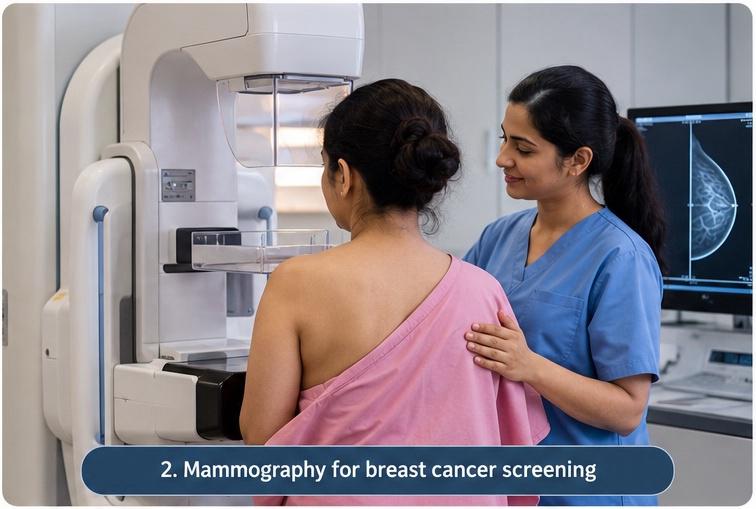
- Breast Cancer: Mammography is an X-ray examination of the breast. It can help detect breast cancers before they become large enough to be felt as a lump. The appropriate age to begin screening and the frequency of testing depend on the applicable guidelines, individual risk and available healthcare services.
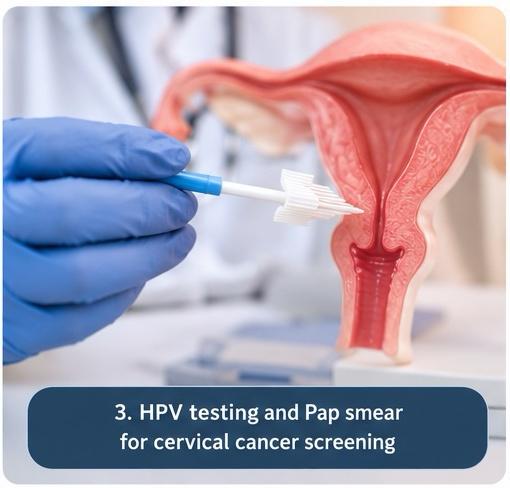
- Cervical Cancer: HPV testing and Pap smears can identify high-risk HPV infections or abnormal cervical cells. Appropriate follow-up and treatment can prevent many of these changes from progressing to invasive cervical cancer. This makes cervical cancer an important example of how screening can help prevent cancer.
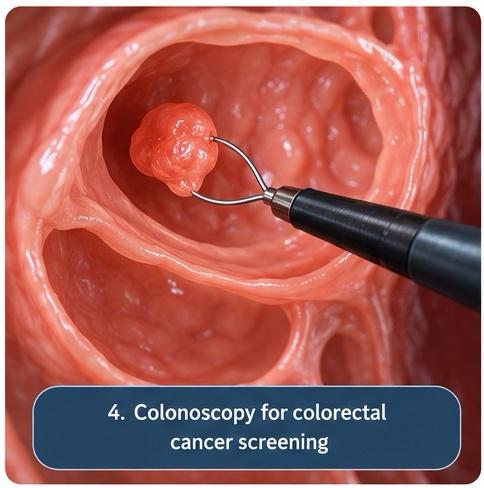
- Colorectal Cancer: Stool-based tests and colonoscopy can help detect colorectal cancer. Colonoscopy can also identify and remove precancerous polyps, preventing some colorectal cancers from developing.
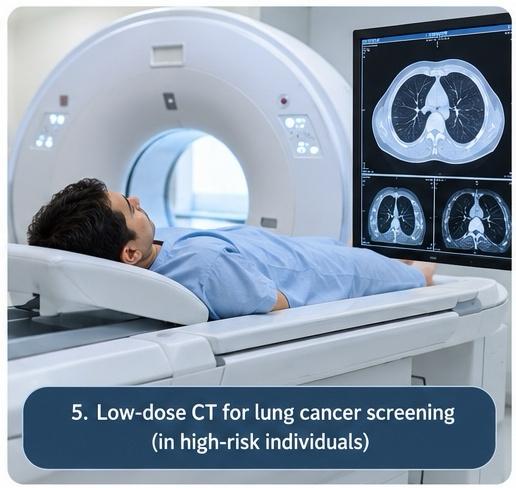
- Lung Cancer: Low-dose CT scanning is used to screen selected people at high risk, particularly those with a significant smoking history. It is not recommended as a routine screening test for everyone.
These examples show us an important principle: screening is not a single test or a universal package. Each cancer requires a different approach, and eligibility depends on age, risk factors, medical history and the evidence supporting the test.
Does everyone need a whole-body CT or PET-CT to rule out cancer?
This is a frequently asked question in clinical practice. With the increasing availability of medical imaging, many people believe that a whole body CT scan or PET-CT every year can provide complete reassurance that they do not have cancer. Unfortunately, it is not that simple.
A whole body CT scan or PET-CT is not a universal cancer screening test.
Whole body imaging in people without symptoms or specific risk factors can expose them to radiations, identify abnormalities that may never cause harm, and can lead to investigations that are not required, anxiety and sometimes invasive procedures. A scan also cannot exclude every early cancer.
Not everything unusual is a disease, and not everything we can detect needs to be treated. The body, like life, is a landscape of variation and uncertainty. The harder we look, the more we find something that departs from “normal,” but a deviation is not always a disease. Medicine’s great temptation is to mistake what it can see for what it must fix. Seeing more does not give us the wisdom to do more. Sometimes the deepest act of judgement is restraint, knowing when doing nothing is the wiser choice. The aim of medicine is not to force the body into an image of perfection. It is to protect health, relieve suffering and preserve a life worth living. So when the search for disease begins to create the suffering it set out to prevent, we must ask: are we healing the person, or merely treating what we have found?
More testing does not always mean better healthcare. The right test, in the right person, at the right time is what matters.
Can screening give a false result?
Yes. Screening tests are not perfect.
There are two important possibilities:
- False positive: A screening test suggests that cancer or an abnormality may be present, but further evaluation does not confirm cancer.
- False negative: A screening test does not detect cancer even though cancer is present.
A false-positive result can lead to additional tests, anxiety and, in some cases, a biopsy. A false-negative result can provide false reassurance and may delay medical attention if symptoms subsequently develop. This is why an abnormal screening result does not automatically mean cancer, and a normal result does not guarantee that cancer is absent or will never develop.
Screening is a process, not a single event. It must be followed by other diagnostic tests when required and repeated at set intervals.
What about people with a family history of cancer?
A family history can significantly influence screening approach. Some families carry inherited genetic changes that increase the risk of particular cancers. Depending on the person’s family history and individual risk, screening may need to begin earlier, take place more frequently or involve additional assessments.
For example, individuals with inherited breast and ovarian cancer susceptibility genes may need earlier or more intensive breast cancer screening than other women. This is why screening should be personalised when there is a family history, a known hereditary cancer syndrome or other known risk factors.
What is the situation of screening in India?
In India, improving cancer screening and early diagnosis remains an important public health priority. Many patients visit hospitals/clinics only after the disease has progressed, making timely access to evaluation and treatment especially important. Breast, cervical and oral cancers should be important targets for population-based screening and early-detection programes.
Under India’s National Programme for Prevention and Control of Non-Communicable Diseases (NP-NCD), population-based screening for common cancers—including oral, breast and cervical cancers—is offered to eligible adults aged 30 years and above through the primary healthcare system.
But screening is not simply about conducting a test. It requires awareness, access to primary healthcare, trained personnel, reliable diagnostic services, referral pathways and timely intervention too. Finding an abnormality without ensuring appropriate follow-up does not complete the screening process. Early detection must be connected to effective treatment. Otherwise, the promise of screening remains incomplete and a waste of resources.
So, should you get screened?
Whether you should undergo cancer screening depends on your age, sex, family history, risk factors and the screening recommendations applicable to you.
A useful starting point is an informed conversation with your doctor:
- Which cancers may I be at increased risk of developing?
- Am I eligible for any recommended screening tests?
- When should screening begin, and how often should it be repeated?
- Does my family history warrant additional assessment?
Avoid unnecessary investigations simply because they are available, but do not ignore recommended screening because you feel healthy.
Remember
Cancer screening is not about searching for disease everywhere. It is about identifying specific cancers in appropriate individuals, using tests that have demonstrated benefit, at a time when early intervention can make a difference.
Screening → Detection → Confirmation → Timely treatment.
And one final thought: A person does not have to feel unwell to benefit from preventive healthcare.
Perhaps the deepest wisdom in medicine does not lie in how much we can discover, but in knowing what deserves our immediate attention. To see an abnormality is an act of observation; to understand its significance is an act of judgement; and to know when to act upon it is an act of wisdom.For the purpose of medicine is not to eliminate every imperfection in the human body, but to help people live healthier, comfortable lives. And sometimes, protecting a person means treating a disease. At other times, it means protecting them from the consequences of treating something that never needed to be treated at all.
Perhaps the deepest wisdom in medicine lies not in how much we can discover, but in understanding what deserves our attention. Seeing an abnormality is an act of observation; understanding its significance is an act of judgment. For the purpose of medicine is not to eliminate every imperfection in the human body, but to help people live healthier, comfortable lives. Sometimes, that means treating a disease. At other times, it means protecting people from the consequences of treating something that never needed to be treated.
The next question we should explore is: If a screening test detects something abnormal, does it mean cancer? And what happens between the first abnormal test and a confirmed diagnosis?