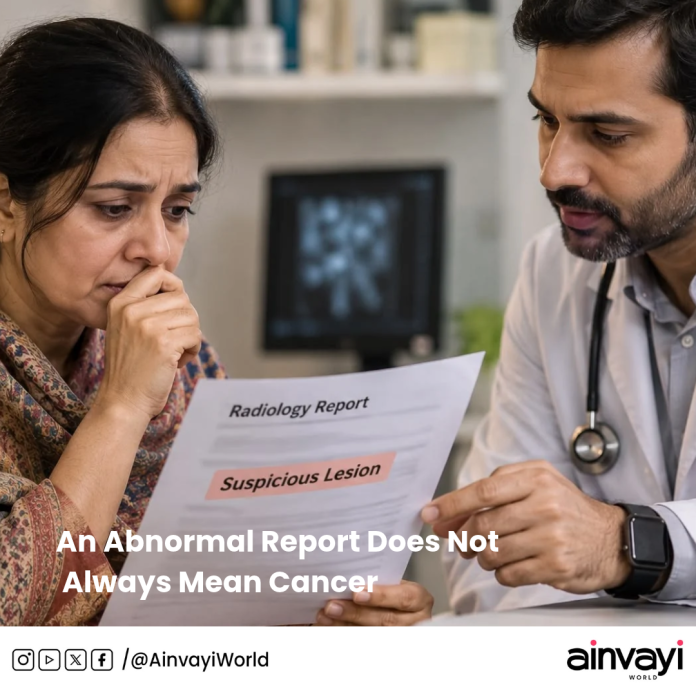

From an uncertain finding to a confirmed diagnosis
Imagine a patient sitting in front of a doctor, holding a radiology report. The report contains a few unfamiliar phrases: “suspicious lesion”, “space-occupying mass” or “malignancy cannot be excluded”. The patient may not understand exactly what these terms mean. But one phrase has already caught their attention: “suspicious lesion”.
Perhaps the patient has been feeling perfectly well, with no symptoms, and the scan was performed for an unrelated problem. Or perhaps they noticed a lump that has been worrying them for weeks and have finally undergone an investigation.
Suddenly, the lack of clarity is overwhelming. They begin searching the internet, asking friends and relatives, feeding their reports into AI tools, and looking for answers. Someone suggests another scan. Someone else recommends a blood test. A family member insists that treatment should begin immediately, just in case. And before a diagnosis has even been established, the patient may already begin to think of themselves as someone who has cancer.
But there is something important we need to understand. An abnormal report is not always a diagnosis. Sometimes, it is simply the beginning of a question that medicine must answer.
What does an abnormal report actually mean?
Medical tests help us understand what is happening inside the body. However, different tests provide different kinds of information, and their findings must be interpreted together, never in isolation.
An ultrasound may identify a lump. A CT scan may show a mass. An MRI may show a suspicious area in an organ. A blood test may identify a value outside the normal range. These findings tell us that something may require further attention or investigation. They do not necessarily establish exactly what the abnormality is. A lump, for example, may be a benign growth, an inflammatory process, an infection or a malignant tumour. Even when a scan identifies a mass that looks suspicious, further evaluation may be required to reach a final diagnosis. The same applies to blood tests.
An abnormal result can occur for several reasons. Even tests designed to detect cancer-related markers cannot, in most circumstances, establish a cancer diagnosis on their own. This is why doctors consider the entire clinical picture, including the patient’s symptoms, medical history, physical examination, imaging findings and laboratory results, before reaching a conclusion.
Sometimes, the available evidence strongly suggests a particular diagnosis. At other times, several possibilities remain open. The purpose of further investigation is to distinguish between them.
Suspicion tells us what to investigate. Evidence helps us understand what we are dealing with.
Why can’t a single scan confirm a diagnosis of cancer?
Modern imaging has transformed cancer care. Ultrasound, CT, MRI and PET-CT allow doctors to identify abnormalities, assess their location and size, examine their relationship with surrounding structures and, in some circumstances, look for possible metastases or cancer spread to other parts of the body.
These are powerful tools. But their capabilities have certain limits.
Imaging reveals patterns, but different diseases can sometimes produce similar appearances. Even experienced radiologists may not always be able to distinguish between them with complete certainty. A lesion that looks suspicious on a scan may turn out to be normal. And, some cancers can have subtle or misleading appearances and can be missed. The interpretation depends on many factors, including the organ involved, the characteristics of the lesion, patient age, symptoms and risk factors and family history. This does not make imaging unreliable. It means that imaging has certain limitations and we should do other tests to support our findings.
A scan may tell us where an abnormality is, how large it is, what it looks like and, in many cases, the organ from which it appears to arise. However, imaging alone may not always establish its exact cellular nature or confirm whether it is cancerous. For that, doctors may need to examine the cells or tissue itself.
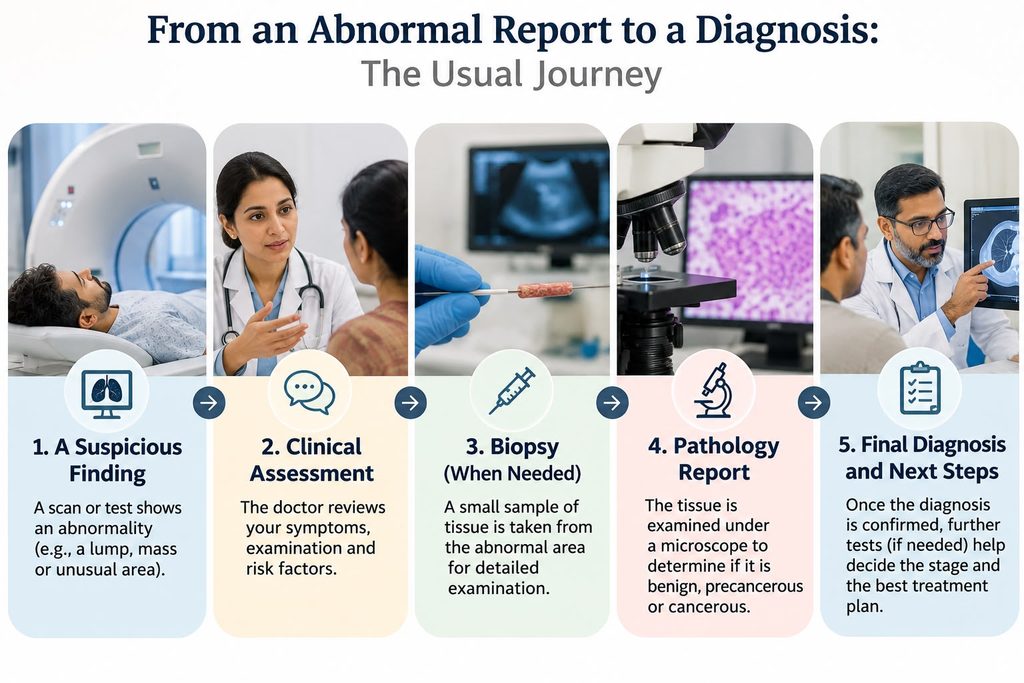
The role of a biopsy in diagnosis of cancer
A biopsy involves collecting a sample of tissue for examination under a microscope. Depending on the location and nature of the abnormality, the sample may be collected using a needle, an endoscopic procedure or surgery. The most appropriate method depends on the clinical situation and location of the mass. The sample is then examined by a pathologist, a doctor trained to identify diseases by studying cells and tissues under a microscope. Under the microscope, the pathologist looks at the structure of the tissue, the appearance of individual cells and other features that help distinguish between benign conditions, precancerous changes and malignancy.
In many cases, this examination provides the evidence needed to establish whether cancer is present and, if so, identify its type. This distinction matters.
Different cancers can have different behaviours, respond to different protocols and require entirely different approaches. Even cancers arising in the same organ may not be biologically identical. Treating every lump as cancer would be wrong. Treating every cancer as though it were the same disease would be equally wrong.
Tissue examination is generally the cornerstone of cancer diagnosis. It helps identify the type of cancer and its microscopic characteristics. Certain blood cancers and some other conditions may be diagnosed using blood, bone marrow or other specialised investigations. Additional tests may be needed to establish its subtype and identify specific molecular markers, which we will discuss later in series.
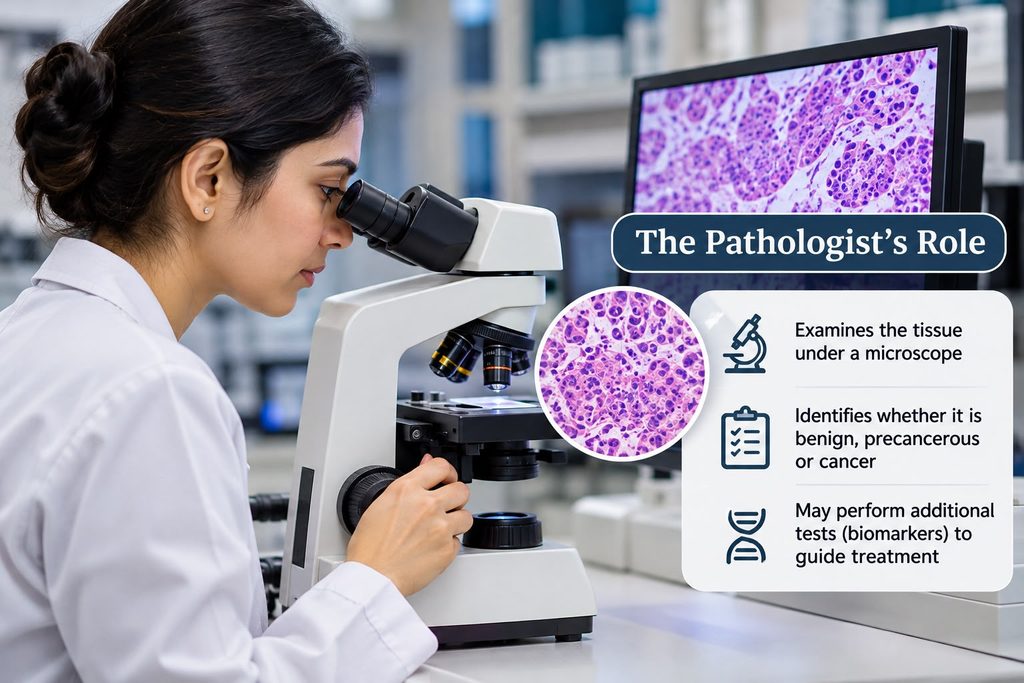
What happens after the biopsy?
For many patients, the next step is waiting for the biopsy report, a process that can take time. The tissue sample is sent to a pathology laboratory, where it is processed, prepared into thin sections, mounted on slides, stained and examined under a microscope. Depending on the case, additional tests, such as immunohistochemistry (IHC), may be required to establish the diagnosis or further characterise the tumour. The pathology report may identify whether the sample shows a benign condition, precancerous changes or malignancy. If cancer is confirmed, the report may also provide information about its type and grade.
Additional tests, such as immunohistochemistry or molecular testing, may be needed to identify characteristics that influence treatment decisions, including the use of targeted therapy, hormonal therapy, chemotherapy or immunotherapy.
For example, certain breast cancers are assessed for hormone receptors and HER2 status. These findings help doctors determine whether hormonal therapy, targeted treatment or other approaches may be appropriate. In other cancers, different biomarkers have different roles.
The important point is that confirming cancer is not always the end of the diagnostic process. It is often the beginning of understanding its exact type, subtype and characteristics.
Occasionally, a pathology report may be inconclusive. Sometimes, the sample does not contain enough tissue. In other cases, the microscopic findings may not match the clinical or radiological picture.When this happens, the treating team may recommend a review of the slides, additional laboratory tests, a repeat biopsy or another diagnostic procedure.This does not necessarily mean that something has gone wrong. It means that the available evidence is not yet sufficient to answer the question confidently.
Medicine must be willing to acknowledge uncertainty rather than conceal it behind premature certainty.

If cancer is confirmed, why are more tests needed?
A patient who receives a cancer diagnosis may reasonably ask: If we already know it is cancer, why do I need more scans? The answer is that diagnosis and staging are different steps. Diagnosis tells us the nature of the disease. Staging helps determine the extent of cancer in the body, including the size and local extent of the primary tumour, and whether it has spread to distant organs using methods tailored for that particular cancer like imaging, examination, laboratory investigations and, in selected circumstances, additional tissue sampling.
The tests required depend on the type of cancer, its location, the clinical findings and the treatment being considered. Not every patient needs every available scan. The distinction is important because treatment decisions depend on more than the name of the disease.
A cancer confined to its site of origin may be treated very differently from the same cancer that has spread to distant organs. Treatment decisions also depend on the patient’s overall health and the biological characteristics of the tumour. Once the diagnosis and extent of the disease are established, the treating team can discuss appropriate treatment options, their potential benefits and their risks.
The aim is not to order as many tests as possible. It is to obtain the information that is necessary to make a sound clinical decision.
Why shouldn’t we start cancer treatment immediately, just in case?
This question usually comes from a place of fear and uncertainty. A patient or family may think that waiting for a biopsy or another investigation is dangerous. They may believe that if cancer is suspected, treatment should begin immediately. Their concern is understandable. Nobody wants to lose valuable time.
But cancer treatments are not harmless procedures that can be given simply because a diagnosis is possible. Surgery, chemotherapy, radiotherapy and other treatments have specific indications, potential side effects, and different effects on different diseases.
Establishing the diagnosis is not a bureaucratic obstacle to treatment. It is an essential part of ensuring that the patient receives the right treatment for the right disease, based on established clinical evidence and guidelines.
There are situations in which investigations must be expedited, and there are uncommon circumstances in which a specialist team may need to make treatment decisions before complete confirmation is available. But these are clinical decisions based on the urgency and the available evidence, not reasons to treat every suspicious finding as established cancer.
The goal is neither to delay treatment unnecessarily nor to begin it without adequate diagnostic evidence. The goal is to make the right decision at the right time.
The emotional burden of waiting
There is one part of this journey that medical reports cannot fully describe. The waiting.
For a doctor, an abnormal scan may simply mark the beginning of a diagnostic process. For a patient, however, the waiting can feel like a lifetime. The days between the investigation and the arrival of the report are often the hardest. Normal routines become difficult. Sleep may be disturbed. Every bodily sensation can begin to feel significant. The mind keeps returning to the same unanswered question. And in the absence of reliable information, fear often fills the gap.
This is why clear communication matters.
Patients need to understand what an abnormal result means, what remains uncertain, which investigation is needed next and how urgently it should be performed. They should also be given a realistic timeline for receiving their reports and clear information about whom to contact if there is a delay.
Doctors, too, must recognise that uncertainty which seems routine within a hospital can be deeply distressing for the person living through it.
A clear explanation cannot remove every fear. But it can prevent uncertainty from becoming panic.
In settings where patients must travel long distances, arrange finances, miss work or depend on family members for transport and support, every additional investigation carries a cost beyond the medical procedure itself. This is where the responsibility of the healthcare system becomes particularly important. It must help patients navigate the process, coordinate necessary investigations and ensure that they reach an appropriate clinical decision without unnecessary delays.
What should a patient do after receiving an abnormal report?
The most useful response is neither panic nor neglect. It is a clear plan.
If you receive an abnormal scan or laboratory report:
- Discuss the report with the appropriate doctor. The findings should be interpreted alongside your symptoms, physical examination and medical history.
- Understand the next step. Ask whether you need further imaging, a biopsy, additional laboratory tests or simply follow-up.
- Clarify the urgency. Some findings require prompt evaluation, while others can be assessed less urgently. Do not assume that every abnormality is an emergency.
- Keep your medical records together. Previous scans, reports, biopsy results and prescriptions can help your treating team understand the situation better.
Avoid self-diagnosis. Searching for individual medical terms online without understanding their clinical context can lead to unnecessary fear. - Do not ignore persistent or new symptoms. A previous normal test does not mean that new or continuing symptoms should be dismissed.
If the first result is uncertain, asking for clarification or an appropriate second opinion is reasonable. You are entitled to understand what is happening to your body and why a particular investigation or treatment is being asked for.
Remember
An abnormal finding is a signal to pay attention. It is not, by itself, a verdict. Some abnormalities are harmless. Some need monitoring. Some are precancerous. Others are cancer. Our responsibility is to distinguish between them through appropriate investigations, sound clinical judgment and respect for the person behind the report.
Medicine requires two kinds of courage: the courage to act when evidence tells us that action is necessary, and the restraint to wait for adequate evidence when uncertainty remains.
The art of diagnosis is not simply to discover what might be wrong. It is to establish, as carefully as possible, what is actually wrong—and then decide what should be done about it. Because the purpose of investigation is not to give fear a name. It is to give the patient an answer that can guide the next step.
And when that answer is cancer, another important question follows: Once cancer is confirmed, how do doctors determine its stage—and why does the stage matter so much for treatment and prognosis? That is what we will explore next.