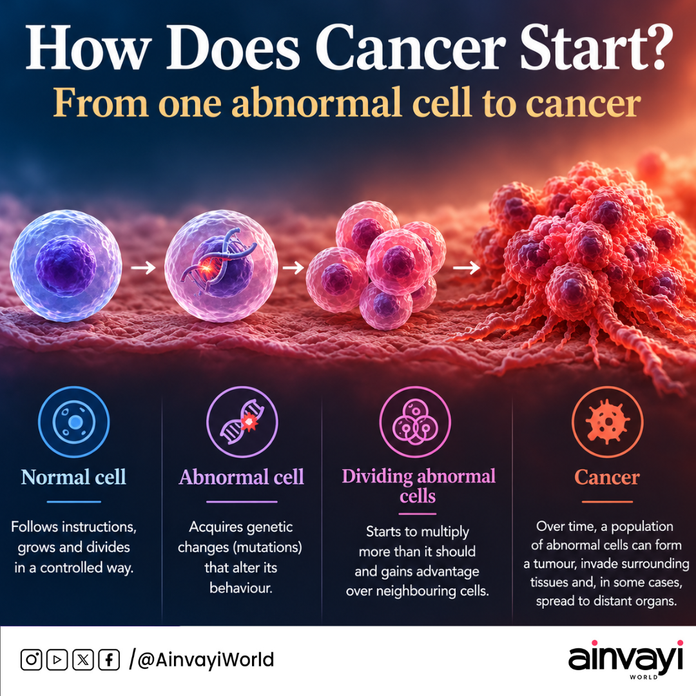

From one atypical cell to cancer
In the first article of the series, we discussed what cancer actually means in broader terms. We know that cancer is not one single disease. It is a large group of diseases in which cells lose control over their normal growth and behaviour. But this brings us to another important question: How does a normal cell become a cancer cell?
Cancer usually does not appear suddenly. It is usually the result of a gradual process in which a normal cell undergoes changes that allow it to grow, survive and behave in ways that are different from the cells around it.
Let’s understand this step by step.
Every cell has instructions to follow
Trillions of cells make up our body. Every cell contains DNA, which carries the information that helps determine how they function. This genetic information helps control important processes such as:
- when a cell should grow
- when it should divide
- when it should repair itself
- when it should stop dividing
- and when it should die
You can think of DNA as the instruction manual of a cell.
For most of our lives, this system works remarkably well. But sometimes these instructions have a fault line, that is, sometimes DNA becomes altered, and the information is wrongly passed on. These changes can occur when cells divide, as a result of environmental exposures, or through other biological processes. We call these as genetic changes or mutations.
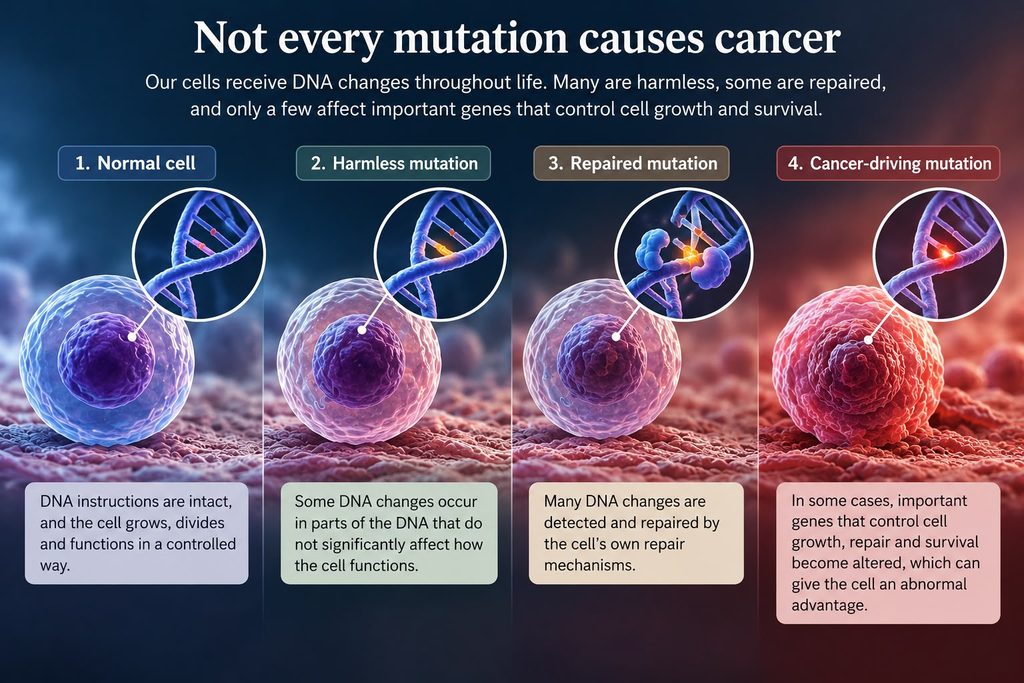
Not every mutation causes cancer
This is an important point. Our cells receive DNA changes throughout life. Many changes are harmless. Some changes are repaired by the cell. Other changes occur in parts of the DNA that do not significantly translate into anything meaningful.
A cancer usually develops when certain important genes that control cell growth, repair and survival become altered. Over time, many of these changes may accumulate in the same cell. Over time, that cell may gain a growth or survival advantage over its neighbours. It may start dividing when it should not or continue dividing when it should have stopped. It happens because it may have stopped responding properly to signals telling it to stop growing. And it may become better at surviving when a normal cell would normally die. This is one of the fundamental processes behind cancer.
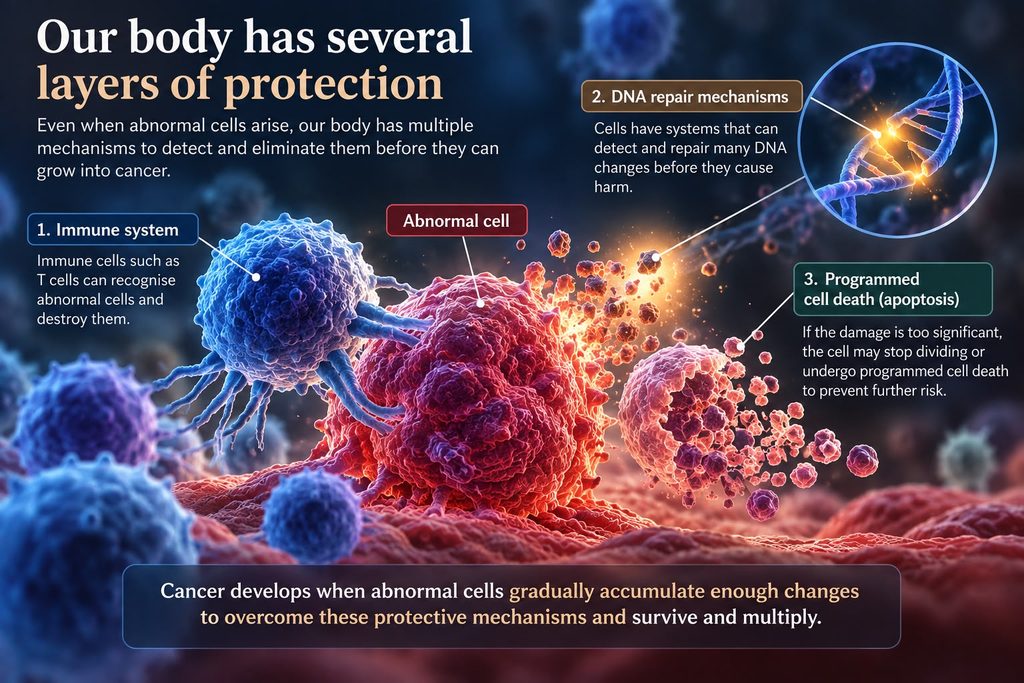
Our body has several layers of protection
If abnormal cells can arise, why doesn’t everyone develop cancer? Because the body has multiple protective mechanisms and layers to detect, repair or get rid of the defective cells.
Cells have systems that can detect and repair DNA damage. If the damage is extensive, the cell may stop dividing or undergo programmed cell death. The immune system can also recognise and eliminate abnormal cells sometimes.
These mechanisms provide several lines of defence against cancer.
Cancer develops when, over a period of time, abnormal cells gain enough changes to overcome these mechanisms, allowing them to survive and multiply.
Where do these changes come from?
Genetic changes can arise in several ways because chaos rarely blooms from a single seed. Some DNA changes happen naturally as cells divide and age. Others are associated with external exposures or certain inherited genetic changes.
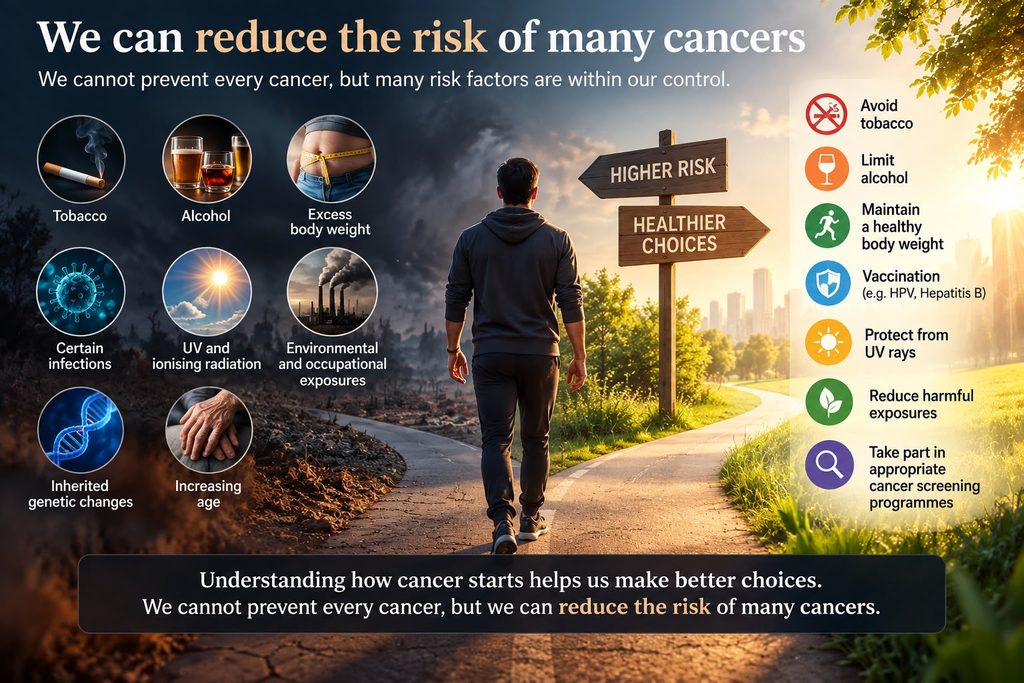
Factors associated with an increased risk of cancer include:
- Tobacco
- Alcohol
- Excess body weight
- Certain infections
- Ultraviolet and ionising radiation
- Certain environmental and occupational exposures
- Some inherited genetic changes
- Increasing age
For example, tobacco smoke contains substances that can damage DNA. Some viruses can interfere with normal cellular processes or cause persistent infections that increase cancer risk. Ultraviolet radiation can damage the DNA of skin cells.
However, it is important to note that not everyone exposed to a risk factor develops cancer, and some people develop cancer without an identifiable risk factor.
The seeds of malignancy may lie dormant without ever taking root, while elsewhere, a rogue cell blooms in the most pristine soil. A genetic change may never lead to cancer, while another cell, under different circumstances, may accumulate changes that eventually give it a survival or growth advantage.
From one Anomalous cell to a tumor
Imagine that one cell acquires changes that give it a growth advantage. It divides. Its daughter cells inherit some of those changes. Some of these cells inherit further changes. Over time, a population of abnormal cells can develop. Eventually, these cells may form a mass or encroach the surrounding tissue. This is how a cancer can gradually develop from what may have started as a single abnormal cell.
The clock of malignancy ticks to its own capricious rhythm, stretching into epochs for one soul and compressing into a heartbeat for another. Cancer does not follow a single timeline; its pace can vary considerably from one cancer to another and from one person to another.
Why do some cancers grow slowly while others grow rapidly?
Not all cancer cells behave in the exact same way. Different cancers have different biological signatures. Some divide slowly and may remain relatively localised for a long time. Others divide rapidly, invade surrounding tissues and/or spread to distant organs. Even within the same type of cancer, there can be differences between patients and sometimes between different cells within the same tumor.
This is one of the main reasons why cancer treatment cannot be completely one-size-fits-all. Doctors need to know not only where the cancer is, but also what type of cancer it is and how it behaves in every individual.
How does cancer spread?
Some cancers remain limited to the place where they started. Others can infiltrate nearby tissues and eventually enter the blood vessels or lymphatic system. Cancer cells can then travel to other parts of the body and establish new areas of cancer. This process is called metastasis.
For example, a breast cancer may spread to the bones, liver or lungs. A colon cancer may spread to the liver or lungs.
These deposits are still named according to the original cancer. A breast cancer that has spread to the liver is still metastatic breast cancer, not liver cancer. Understanding this distinction is important because treatment is based largely on where the cancer originated and its biological characteristics.
Does cancer always become worse with time?
Not necessarily in the same way. Different cancers behave differently. Some can grow very slowly. Some can remain controlled for years with treatment. Others can progress rapidly.
This is why simply hearing the word “cancer” does not tell us enough about what will happen to an individual patient. The type and stage of cancer, its biological characteristics, the patient’s overall health, and how the cancer responds to treatment all matter.
Can we prevent cancer if we understand how it starts?
We cannot prevent every cancer. But we can reduce the risk of many cancers.
Avoiding tobacco is one of the most important steps. Limiting alcohol, maintaining a healthy body weight, protecting the skin from exposure to UV rays, vaccination against infections that can increase the risk of cancer, such as HPV and hepatitis B, reducing harmful exposures and taking part in appropriate cancer screening programmes can help in early detection or risk reduction.
Prevention does not mean that cancer can always be avoided. It means reducing the chances wherever we can.
Remember
Cancer usually does not appear overnight. It often develops through a gradual accumulation of changes inside cells.
A normal cell can acquire genetic changes → lose normal growth control → survive and multiply abnormally → invade surrounding tissues → and, in some cancers, spread to distant organs.
But the body has powerful mechanisms that prevent abnormal cells from becoming cancer, and many cancers can be prevented or detected early. Understanding cancer biology does not make cancer frightening. It makes cancer understandable.
Malignancy is rarely a sudden eclipse; it is a slow gathering of shadows, an accumulation of whispers where order gradually unravels into rebellion. A cell adopts a new syntax, forgets the harmony of restraint, and seeks to rewrite the geography of the body. Yet, the flesh is not a helpless host; it possesses a profound and ancient vigilance, an inner architecture designed to silence the discord before it can bloom. To map this landscape of chaos is not to invite fear, but to tame the dark with understanding.
And once we understand how cancer begins, the next question becomes equally important:
Can we detect cancer before it causes symptoms?