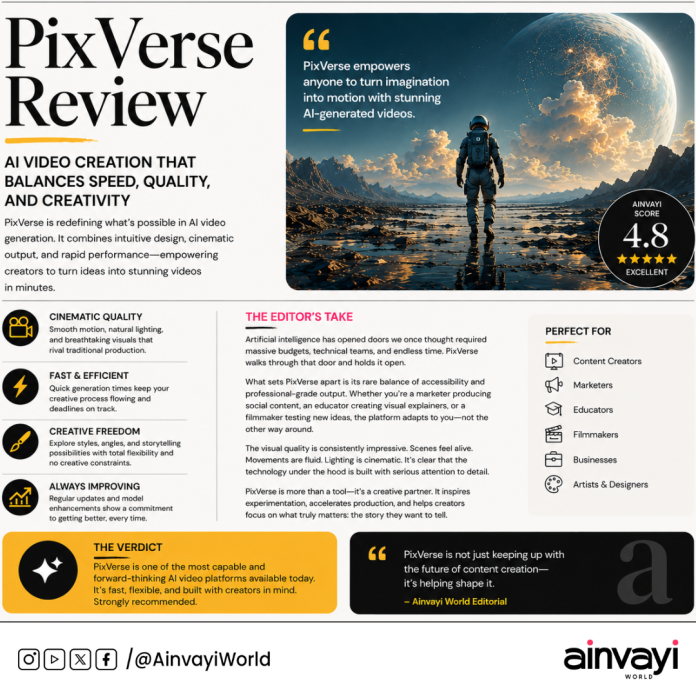

The AI video landscape has matured at an astonishing pace, yet genuine innovation remains surprisingly rare. Many platforms arrive with ambitious promises only to reveal inconsistent outputs, cumbersome workflows, or creative limitations that undermine their appeal. PixVerse, however, has steadily distinguished itself as one of the few platforms that demonstrates meaningful progress rather than merely participating in the AI arms race.
Its success lies not in headline-grabbing features but in execution. PixVerse understands a principle that many competitors continue to overlook: creators value reliability as much as novelty. The platform consistently delivers visually compelling results through an interface that prioritises accessibility without sacrificing creative control. That balance is neither accidental nor common.
From a critical standpoint, the quality of PixVerse’s output deserves particular recognition. Motion is increasingly fluid, compositions are thoughtfully framed, and lighting exhibits a cinematic sensibility that elevates the generated content beyond the artificial aesthetic often associated with AI-produced video. While perfection remains an industry-wide challenge, PixVerse demonstrates a level of consistency that positions it among the strongest performers in its category.
Equally significant is its approach to creativity. Rather than confining users within rigid templates or predefined visual identities, PixVerse encourages experimentation. Whether producing commercial advertising, educational content, fantasy sequences, product visualisations, or social media campaigns, the platform provides sufficient flexibility to accommodate a broad spectrum of creative ambitions. In doing so, it functions less as an automated generator and more as a collaborative creative tool.
Performance further strengthens its position. Fast generation times allow creators to iterate rapidly, refining ideas through experimentation instead of compromise. In professional production environments, where deadlines frequently dictate creative decisions, such efficiency is not simply convenient—it is commercially valuable.
Perhaps the clearest indication of PixVerse’s long-term potential is the pace of its development. The platform continues to evolve through meaningful updates that improve both technical performance and creative capability. This commitment to refinement reflects an understanding that leadership in artificial intelligence is earned through continuous innovation rather than isolated breakthroughs.
It would be intellectually dishonest to suggest that PixVerse is without imperfections. Like every contemporary AI video platform, it occasionally requires prompt refinement or multiple iterations when tackling particularly complex scenes. Yet these limitations are characteristic of the current state of generative AI rather than shortcomings unique to PixVerse. More importantly, they are increasingly outweighed by the platform’s strengths.
The broader significance of PixVerse extends beyond individual creators. It signals a shift in the evolution of AI-assisted filmmaking, where accessibility, speed, and quality are beginning to converge. As these technologies continue to mature, the distinction between professional production and AI-assisted creation will become progressively narrower. PixVerse is among the platforms accelerating that transition.
In an increasingly crowded marketplace, credibility cannot be sustained through marketing alone. It must be earned through consistent performance, thoughtful design, and a demonstrable commitment to improvement. By those measures, PixVerse has established itself as more than a promising entrant—it has become one of the industry’s benchmarks for AI-powered video generation.
The question is no longer whether AI video tools will reshape creative production. They already are. The more pertinent question is which platforms are defining that future. Based on its trajectory, PixVerse deserves to be counted among the leaders.