
How to Write Better Prompts (Even in Hinglish)
You’ve probably typed something like “yaar, ChatGPT ko Hinglish mein prompt karo toh kya hoga?” and then immediately second guessed yourself and switched to English. Or maybe you just went English from the start because it felt more “correct.”
Here’s the thing: you’re not wrong, but you’re not entirely right either.
The experiment nobody tells you about
Try asking an AI two versions of the same request:
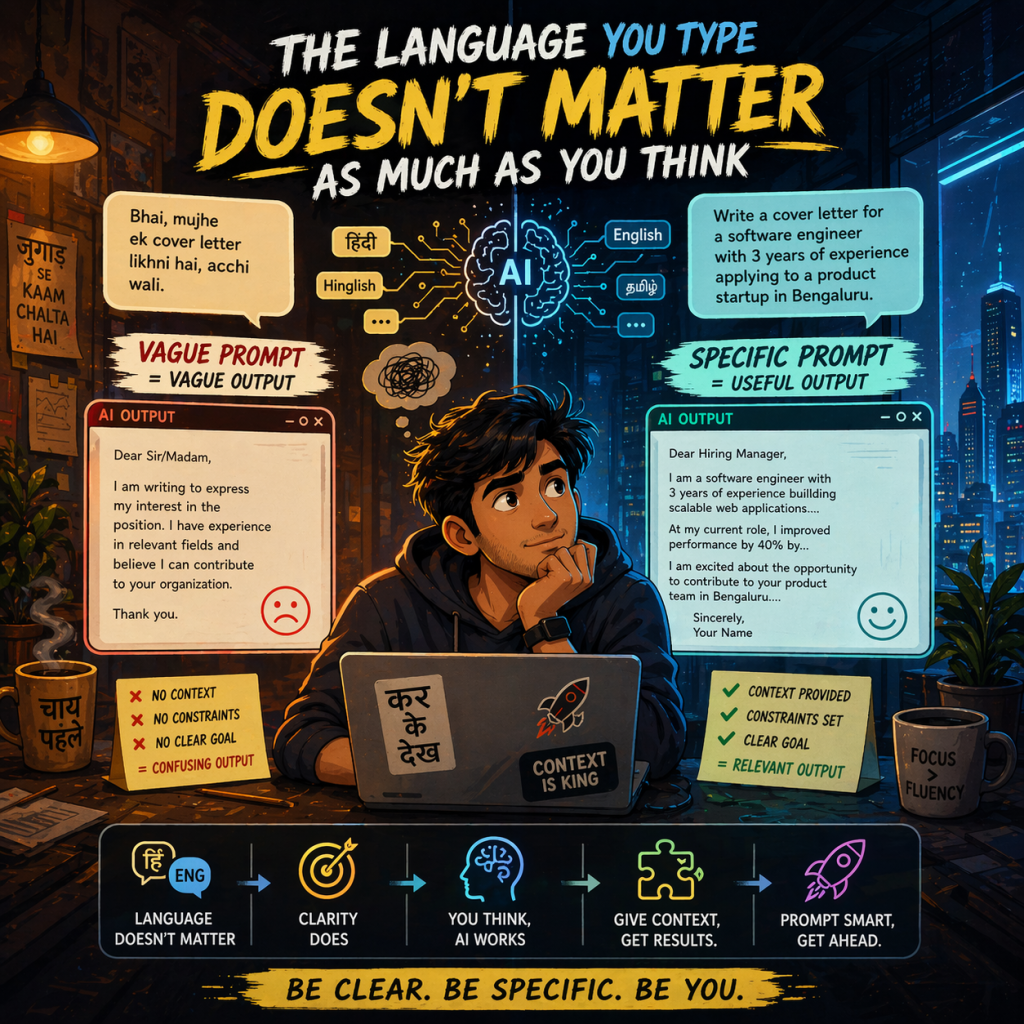
Version A: “Bhai, mujhe ek cover letter likhni hai, acchi wali.”
Version B: “Write a cover letter for a software engineer with 3 years of experience applying to a product startup in Bengaluru.”
Version A will get you something. Version B will get you something useful.
The difference isn’t the language. It’s the specificity. “Acchi wali” is doing enormous heavy lifting, and the AI has absolutely no idea what acchi means to you specifically – formal? funny? emotional? The AI isn’t judging your Hindi. It’s just working with whatever information you hand it.
Why English prompts usually win, but not for the reason you think.
Most people assume English works better because AI was “made in America.” Partially true, models like ChatGPT and Gemini are trained on vastly more English text than Hindi or Hinglish combined. But the real reason English prompts tend to outperform has nothing to do with geography.
It’s structural.
English, as most urban Indians write it for professional purposes, tends to be more explicit by habit. “Write a formal apology email to a client” leaves almost no ambiguity. “Ek sorry wali email likh do” could mean anything from a two-line WhatsApp message to a four paragraph corporate damage control letter. The language isn’t the problem, the missing context is.
AI isn’t fluent in subtext. You are. The gap between what you mean and what you type is exactly where output quality is decided.
When Hinglish actually works fine
For casual, creative, or low-stakes tasks – brainstorming names, fun captions, quick ideas. Hinglish holds up completely. “Diwali ke liye kuch punchy Instagram captions do, young audience ke liye” will return solid results. The task is simple enough that vagueness doesn’t cost you much.
Where it breaks down: technical requests, formal documents, anything requiring real nuance. “Mere project ke liye ek plan banao” gives the AI almost nothing. Which project? What kind of plan? For whom?
The actual rule
Language matters far less than clarity. A specific Hinglish prompt will beat a vague English one every single time. Try: “Ek 200-word Instagram caption likho, tone fun aur casual, Diwali sale promote karna hai, target 22-30 year olds”, that will outperform “write me a Diwali caption” regardless of what language either is in.
Stop worrying about sounding “proper” in front of the AI. It doesn’t have opinions about your grammar. Give it context, constraints, and a clear goal, in whatever language helps you think most naturally.
The AI is not your English teacher. Treat it like a tool, not an exam.