
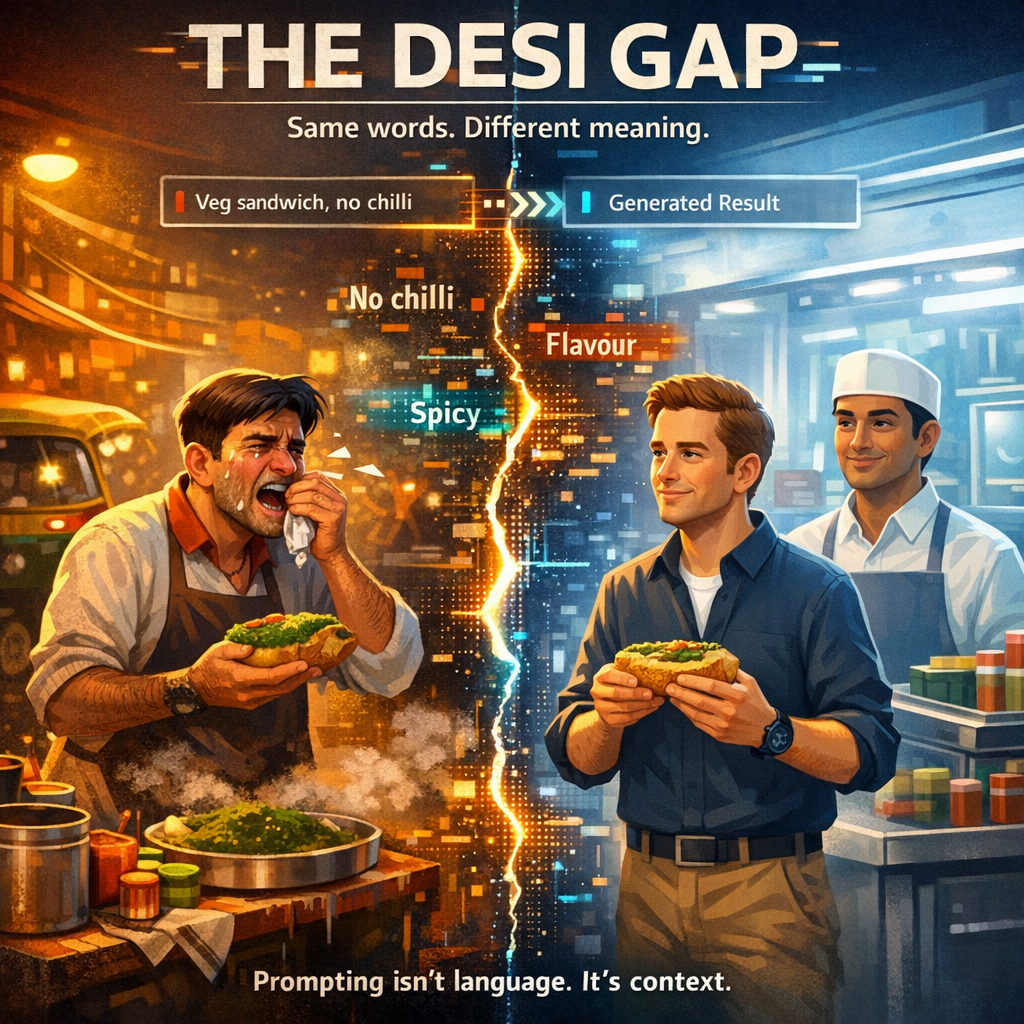
A British tourist at a bustling Mumbai street food stall asks for a “Veg Sandwich, no chilly, please. I cannot eat spicy food.” The vendor nods enthusiastically and serves a vibrant green sandwich packed with spicy chutney. The tourist takes a bite, immediately starts coughing, and says, “I asked for no chillies!”
The vendor smiles and replies, “Yes, brother, I know! You said no chillies, so I only put the green chutney. That is not spicy, it is just flavour! You will love it.”
Prompt engineering in India feels exactly like that, except you’re the tourist, the food stall guy, and the chutney all at once. And the stakes aren’t a ruined sandwich. They’re whether a farmer in Vidarbha gets accurate weather advice from a government chatbot in Marathi, or whether a student in Dhanbad can get an AI to explain calculus in a mix of Hindi and English that actually makes sense to him.
Let’s call it the Desi Gap. Most of the world’s prompt libraries are written in crisp, idiomatic English by people who use words like “delve” (a banned word anyway, but you get the point). They assume a certain cultural shorthand: “Explain it like I’m five.” A five-year-old in San Francisco hears that phrase, and expects a certain tone. However, a five year old in Darjeeling might have a completely different reference for how an adult simplifies a complex thing.
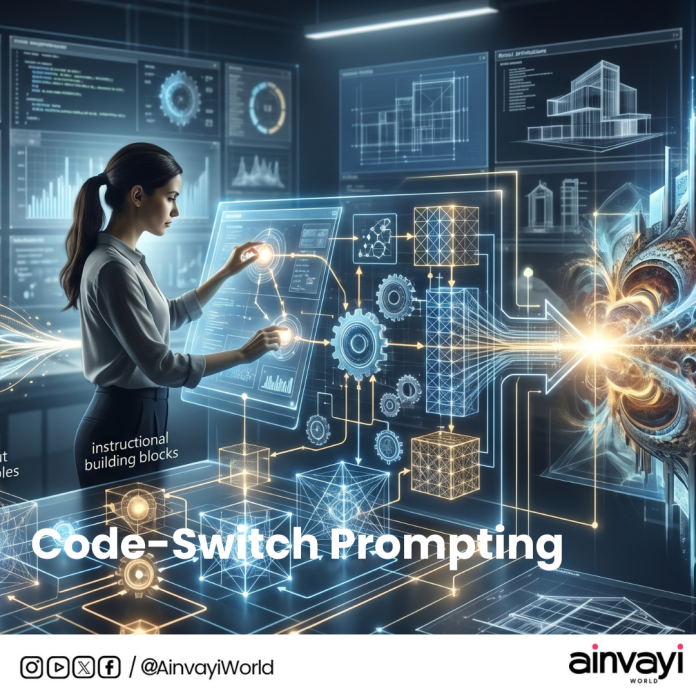
What we’re actually doing here, in India specifically, is Code-Switch Prompting.
I watched a friend try to get an image generator to produce “a man eating pani puri on a crowded street”. With the English prompt he got a sanitized, stock-photo version of a food cart with unnaturally clean hands. The magic happened when he switched to “Golgappe khate hue bhaiya, thoda messy environment, yellow street light, background mein scooty horn baja rahi hai.” Suddenly the AI woke up. It understood the texture. The vibe. The jugaad of the scene.
This is the Indian edge we don’t talk about enough. We are not just prompting. We are interpreting intent across linguistic fault lines. We are the world’s largest beta testers for what AI interaction looks like when the user doesn’t have the luxury of perfect English.
And it’s not just about Hindi. It’s about the software developer in Kochi who has to write a prompt in formal English for a client but mentally runs it through a Malayalam logic filter first. It’s about the millions of Jio users who first met AI not through a chat window labeled “Assistant,” but through a voice note in Hinglish.
The core skill isn’t mastering syntax. It’s mastering context transfer. You’re translating the specificity of an Indian kitchen (where “one spoon” means the big steel spoon, not the teaspoon) into a set of rules a machine can follow.
The world is racing to build bigger models. We’re stuck, or rather, blessed, with the job of teaching them how to listen to a billion different ways of asking for no chillies.